

For many couples planning a wedding in Yemen in 2026, the path to marital happiness is blocked by an extremely complex bureaucratic system. The combination of strict Sharia regulations, the requirement for personal approval from the Ministry of Interior, and the unstable operation of consular services turns the marriage registration process into an exhausting ordeal. In a situation where obtaining each certificate can take months, the concept of an easy marriage abroad becomes the only practical way for Yemeni citizens and foreigners residing in Yemen to legalize their relationship without unnecessary stress. In this context, Georgia emerges as the ideal alternative, offering a transparent and fast procedure. Legal marriage in Georgia for foreigners usually requires nothing more than valid passports and translated documents, a stark contrast to the rigid requirements of Yemeni law. In this article, we will examine the specific challenges couples face in Yemen and explain why Kate&Co Weddings recommends Georgia as the most reliable haven for your union.
Marriage in Yemen: an overview
Getting married in Yemen is a process in which the personal feelings of the couple come last, after strict Sharia rules and stringent state oversight. There is no concept of a secular marriage here; every union is viewed through the lens of religious law and requires the mandatory involvement not only of families but also of higher government authorities. If you are considering a foreigners wedding in Yemen, it is crucial to understand that the procedure differs fundamentally from familiar European or international standards. The main challenge of getting married in Yemen lies in the dual barrier of religion and administration. Every application undergoes meticulous scrutiny by the Ministry of Interior, which assesses social status, religious affiliation, and even the political reliability of the partners. In 2026, this level of control has only intensified, turning formal registration into months of waiting for permits that can be revoked at any stage without explanation.
Legal barriers for Yemeni citizens
Yemen’s legal framework turns the process of getting married into a complex challenge, where every step is tightly regulated by both state and religious institutions. Even for citizens of the country, Yemen marriage laws set strict boundaries that require not just formal consent but a thorough review of the couple’s background, social status, and religious affiliation. In 2026, against the backdrop of unstable government operations, these barriers have become even more pronounced. The main legal challenges include:
- Mandatory Ministry of Interior approval: Obtaining written consent from the Minister of Interior is a critical requirement; without it, marriage registration is legally impossible.
- Role of the legal guardian (Wali): For women, it remains mandatory to secure written approval from their father or another legal guardian, whose involvement in the process is strictly monitored.
- Medical certification: Couples are required to provide up-to-date medical certificates and test results for infectious diseases, including HIV, issued by officially certified laboratories within the country.
- Financial and contractual obligations: The marriage contract must clearly specify the amount of the mahr, and the husband is obliged to provide documented proof of his ability to support the family.
Such a multi-layered control system means that marriage in Yemen is often delayed indefinitely due to bureaucratic hurdles. Couples may wait months for decisions from various authorities, facing the risk of rejection at any stage. In contrast to this exhausting procedure, modern alternatives allow couples to legalize their union much faster and without having to navigate so many administrative obstacles.
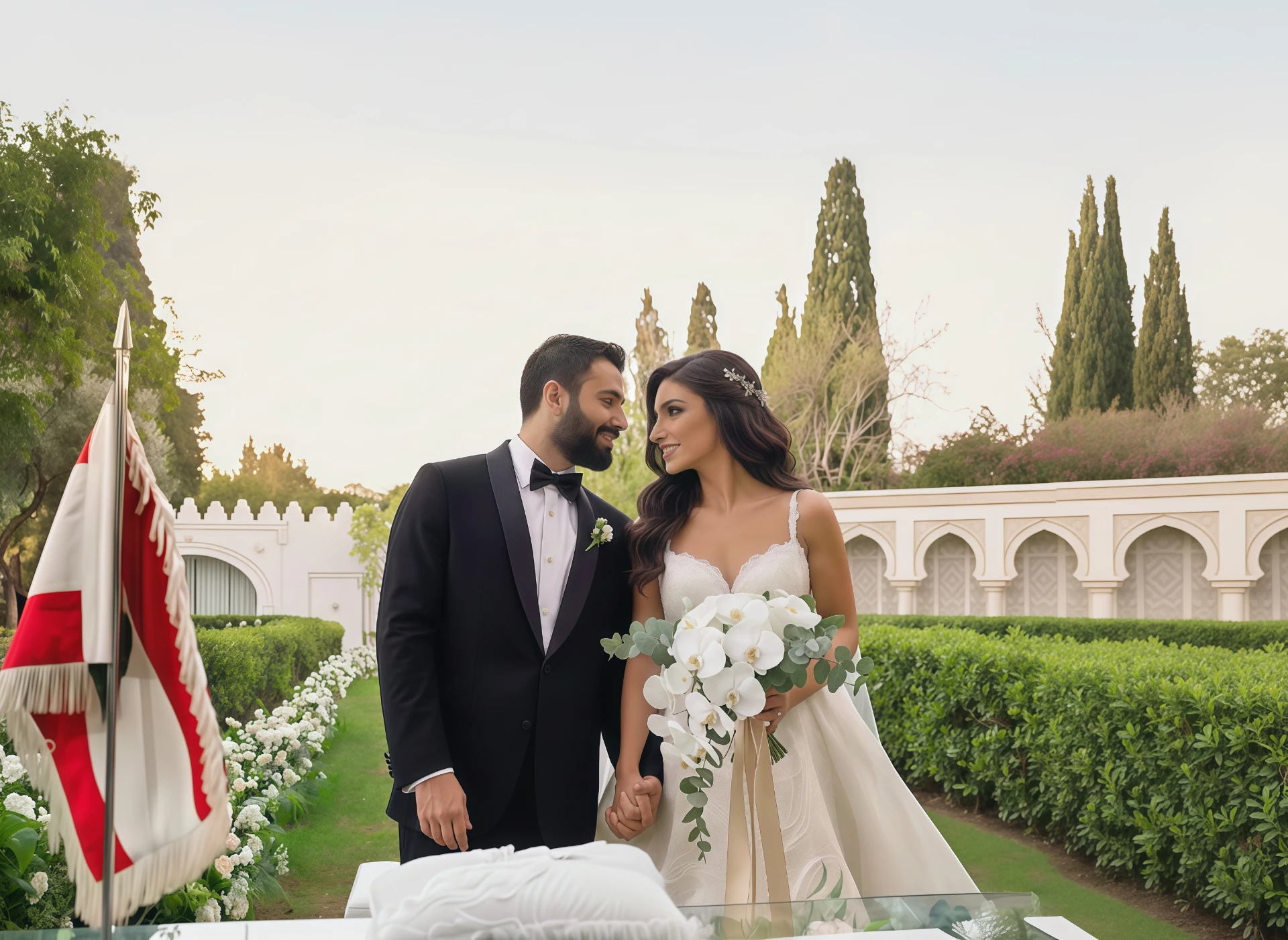
 Outdoor ceremony in Gudauri for a foreign couple (Yemeni citizen + UAE citizen)
Why it’s even harder for foreigners
If getting married in Yemen is already a complex quest for local residents, for foreigners or international couples the process becomes a true test of endurance. The state examines such unions under a microscope, checking everything – from your religious beliefs to your bank accounts and even the age difference between partners. Here are the real challenges couples face when planning a marriage in Yemen for foreigners:
- Uncompromising religious requirements: There is no concept of a secular marriage in Yemen. Everything is governed by Sharia law. If the bride is a Yemeni citizen, the foreign groom must be Muslim. This is not just a formality: you would have to officially convert to Islam under the supervision of local authorities and obtain documentation of this. Conversely, if the groom is Yemeni, his bride must be either Muslim, Christian, or Jewish. If you do not fall into these categories, there is no legal path to marriage. In such situations, legal marriage for expats is much easier to arrange in Georgia, where your faith is a personal matter and no one will require you to change religion just to get a stamp in your passport.
- Marriage legalization difficulties: The biggest challenge begins after the wedding. Yemen is not a party to the Hague Convention, so there is no globally recognized apostille. To have your marriage certificate recognized in Europe, many Asian countries, or the United States, you would need to follow a long process: notarization at the Ministry of Justice, then approval from Yemen’s Ministry of Foreign Affairs, and finally legalization at the embassy of the country where you plan to use the document. In 2026, with many consulates operating irregularly, this process can take months. By comparison, in Georgia we can apostille your marriage certificate in just one day, and it is automatically recognized in 120+ countries worldwide.
- Ministry of Interior approval and the “No Objection Certificate”: Foreigners must obtain approval from their embassy, a so-called No Objection Certificate confirming that their country has no objection to the marriage. If your embassy in Sana’a is currently closed or operating at limited capacity, obtaining this document locally is technically impossible. Additionally, Yemen’s Ministry of Interior checks the age difference (which must not exceed 20 years) and requires the groom to prove financial capability with official bank statements.
- Medical tests: Beyond standard procedures, foreigners are required to provide an official certificate confirming they are free from HIV and other infectious diseases, issued only by a certified clinic in Yemen.
In theory, registering a marriage in Yemen for foreigners is possible, but in practice, it carries a high risk of getting stuck in a bureaucratic deadlock with a document that may later not be recognized abroad. This is exactly why couples choose Georgia: here, all you need for registration is a valid passport, and the result is an internationally recognized marriage within 24 hours.
Our unforgettable moments




Social and cultural challenges
Behind Yemen’s official laws lie centuries-old traditions, which often carry more weight than a minister’s signature. For a couple – especially if one partner is a foreigner – social pressure can be even more exhausting than the paperwork itself. Here’s what you need to know about the country’s cultural climate in 2026:
- The power of tribal traditions: In Yemen, marriage is primarily a transaction between clans. If you plan to marry a citizen of the country, you automatically enter into a relationship with their entire family. Tribal norms dictate their own rules, from approval by elders to strict requirements regarding the social status of the partner. For a foreigner, integrating into this structure without arousing suspicion or undue curiosity is extremely challenging.
- Gender restrictions and the role of the guardian: Family influence over women in Yemen is absolute. The concept of “independent choice” barely exists within the legal framework. The guardian (wali) does not just give formal consent; he fully controls the process. If the family considers the marriage “unsuitable,” they can block it at any stage, even if you have official approval from the authorities.
- Social approval and being “under a microscope”: Mixed couples often face constant scrutiny from neighbors, the local community, and religious leaders. This creates an atmosphere of continuous pressure. The foreign husband may be expected not only to adopt the local faith but also to fully immerse himself in local customs – a demand that is not always realistic for a modern individual.
- Marriage as a financial burden: Cultural expectations often include holding large celebrations and paying a substantial mahr. For foreigners, the “entry cost” may be artificially inflated by the bride’s family, turning what should be a romantic story into a complex financial transaction.
In contrast to this conservative environment, Georgia offers couples complete freedom from social prejudice. Here, your wedding is your personal space. No one will check your lineage, seek permission from your relatives, or evaluate your religious beliefs. At Kate&Co Weddings, we see how couples literally breathe easier once they arrive in Tbilisi, where the focus shifts from “meeting traditional expectations” to celebrating love.
 Quick marriage registration in Tbilisi (Georgia) for couples from Yemen
Yemen vs. Georgia: key differences for marriage
When it comes to choosing a wedding location, it’s important to understand that you are not just selecting a place – you are choosing the legal framework in which your family will exist. The difference between the requirements in Yemen and Georgia in 2026 is enormous. While the Yemeni system is focused on total control and scrutiny of every step you take, Georgian legislation is built on principles of freedom and support for international couples. Below is a clear comparison to help you evaluate the level of bureaucracy and realistic timelines in both countries:
| Criterion | Yemen | Georgia |
|---|---|---|
| Type of marriage | Sharia contract with legal registration through the court | Civil marriage, officially registered by the civil registry |
| Religious requirements | Mandatory compliance with Sharia; marriage of a Muslim woman to a non-Muslim is prohibited | No religious restrictions; marriage is open to all faiths |
| Guardian consent | Mandatory for the bride (wali) | Not required; both parties give personal consent |
| Documents | Extensive package: ID, Ministry of Interior approvals, medical certificates, proof of financial capacity, guardian consent | Minimal package: passport, health insurance |
| Processing time | Months; multiple stages, checks, and approvals | Usually 1–2 days; fast and transparent |
| Bureaucracy | High; involves Ministry of Interior, courts, notaries, consulates | Low; registration through civil registry, simple procedure for foreigners |
| Recognition abroad | Requires consular legalization; mixed marriages are more difficult to recognize | Internationally recognized; apostille ensures legality in most countries (consular legalization possible) |
| Age restrictions | Age difference ≤ 20 years | No age restrictions (as long as both parties are 18+) |
| Financial and medical requirements | Proof of financial capability, medical certificates, HIV test | Not required |
| Difficulty for international couples | Very high | Minimal; specifically designed for foreigners and mixed couples |
As the table shows, Georgia removes nearly all the barriers that make marriage in Yemen so complicated. While the Yemeni system evaluates your “eligibility” for marriage, Georgian law simply formalizes your right to be together.
What would you like?



Why Georgia is the best option for international couples
If Yemen represents a difficult path full of barriers, Georgia is a wide-open door. Today, for many couples, international marriage in Georgia has become synonymous with peace of mind and confidence in the future. Here, the marriage registration process is transformed into a convenient service where the main protagonists are you, not officials buried in piles of paperwork. So why is getting married in Georgia (the country) the best decision for those who want a stress-free wedding?
- Minimal documents – maximum results: Forget about income certificates, Ministry of Interior approvals, or medical test results. For marriage in Georgia, foreigners only need their original passport and a notarized translation into Georgian. To enter the country, you will need health insurance covering the entire duration of your stay.
- International recognition without complications: A marriage certificate issued in Georgia is recognized in the EU, the USA, the UK, and most Arab countries. Because Georgia is a participant in the Hague Convention, we can apostille your certificate in the shortest possible time, making it legally valid worldwide. For recognition in Yemen, Saudi Arabia, or the UAE, we provide consular legalization.
- No religious pressure: Georgia is a modern secular country. No one is concerned about your faith or nationality. You can belong to different religions or none at all – the law equally protects the right of every couple to start a family.
- Speed that impresses: The entire process – from filing the application to receiving the finalized certificate with an apostille – can take as little as 24 hours. It’s the perfect solution for those who value their time.
- Marriage and celebration in one package: Choosing an easy wedding for international couples allows you to combine the official ceremony with an unforgettable experience. You can register in a futuristic House of Justice or select a romantic Wedding Palace, then head off for a photoshoot in the mountains or the historic streets of Tbilisi.
At Kate&Co Weddings, we handle all the “boring” parts – from translations to liaising with government offices. We know how to make the path to a legal marriage for couples from Yemen as beautiful and effortless as Georgia itself. While other countries look for reasons to say “no,” we create the conditions for your “yes.”